Treat protocols as conjectures.
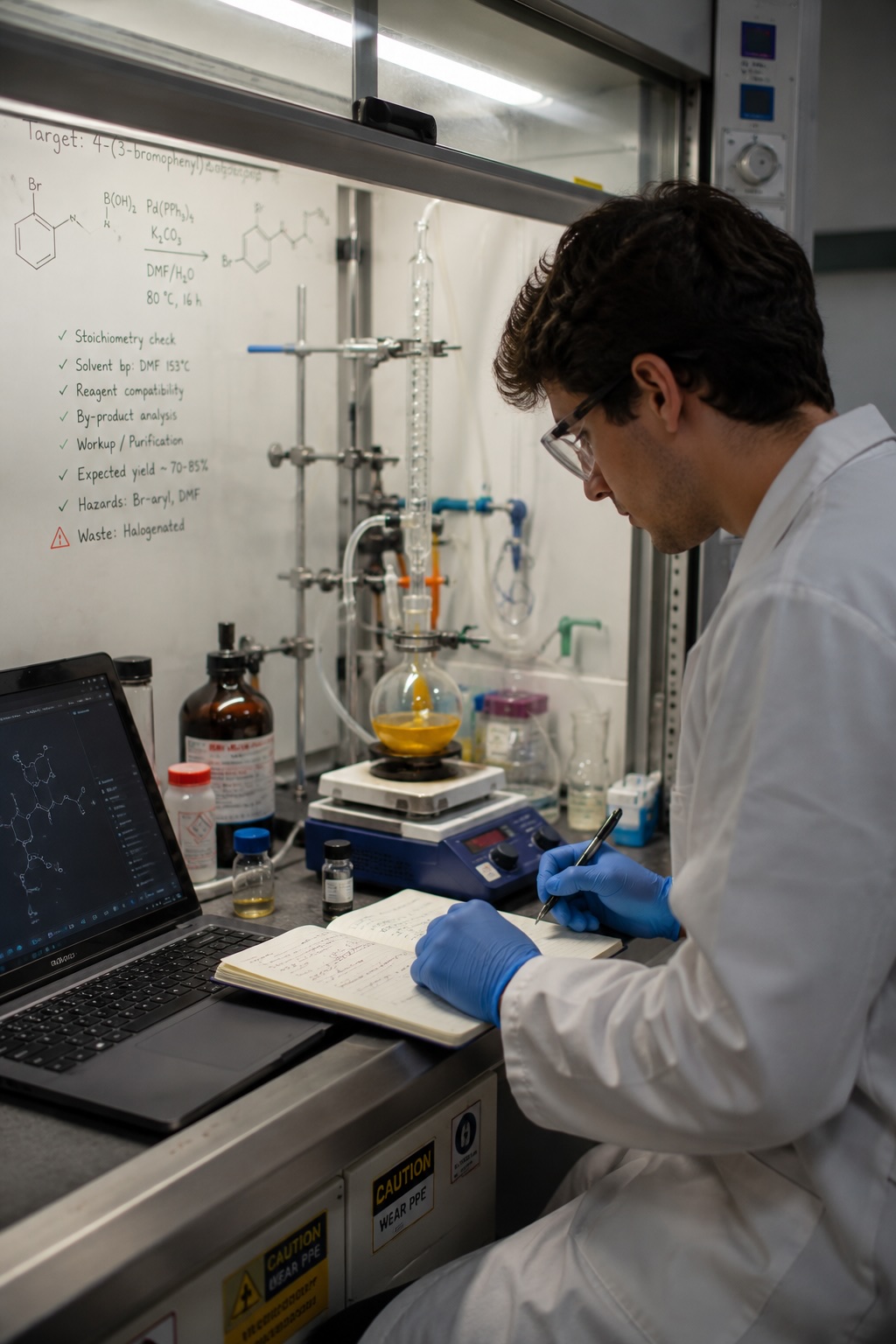
Vicena helps build protocol drafts from literature evidence, then audits them like a proof-checking problem: if these steps run under these conditions, should this product or result follow?
Builder
Audit
Certificate
Source-backed draft
Builder starts the claim.
Conjecture
If the stated reagents, order, vessel, temperature, timing, purification, and controls are correct, the target result should follow.
Check
Conservation
Check
Yield
Check
Compatibility
Check
Hazards
Audit certificate
- Status and audit summary
- XDL-aligned protocol preview
- Findings with blockers, warnings, gaps, and notes
- Proof obligations and assumptions
Evidence first
Protocol Builder searches source material, separates source-backed details from assumptions, and keeps missing critical details visible.
Protocol as conjecture
The draft claims that if these steps run under stated conditions, a specified product or observation should result.
Audit before lab
Protocol Audit checks the claim against chemistry, physics, operational constraints, hazards, and coverage gaps.
Certificate for iteration
The audit certificate records findings, proof obligations, assumptions, boundaries, provenance, and unresolved gaps.
Why this matters
Find protocol failure points before they become lab delays.
The expensive part is not only chemicals or instrument time. It is waiting through a workflow that could have been challenged earlier. Protocol Design gives the agent a way to draft, formalize, audit, revise, and preserve the reasoning trail before execution.
Reverse from the target
Start from a desired research material, assay, observation, or product. Vicena can work backward through published route fragments and expose what is known versus inferred.
Assemble across sources
Builder combines literature context into a structured draft with materials, equipment, steps, timing, QC, assumptions, and gaps instead of flattening everything into prose.
Audit the implied claim
Audit asks what must be true for the protocol to produce the claimed result, then tests what it can against deterministic chemistry and evidence tools.
Carry the certificate forward
The certificate becomes the revision file: blockers, warnings, unproved assumptions, and provenance stay attached to the next protocol draft.
Audit surface
Proof obligations for wet-lab plans.
Instead of logical postulates, the audit works through chemical and physical constraints. Tools return evidence, boundaries, and gaps. The agent synthesizes a review without pretending that an unverified protocol is validated.
Atom and mass conservation
Balance, stoichiometry, limiting reagents, missing species, and conservation-law violations.
Yield bounds
Expected yield versus theoretical yield, reagent excess, scale assumptions, and impossible claims.
Compatibility
Reagent-reagent and reagent-vessel concerns from curated chemistry rules and structural checks.
Thermal and phase constraints
Boiling point, vapor pressure, solvent, reflux, pressure, and temperature boundaries where data is available.
Hazards and handling gaps
PubChem GHS evidence, explicit missing-data warnings, and concerns that need expert review.
Unproved obligations
Inputs the tools cannot verify yet, assumptions the draft depends on, and conditions to resolve before execution.
Iteration loop
Design, audit, patch, repeat.
This is not a one-shot recipe generator. It is a protocol design loop that turns vague confidence into reviewable obligations before lab execution.
Work backward from the target
Name the target material, product, assay, or observation and the practical constraints.
Build a source-backed draft
Assemble steps, materials, equipment, timing, quality controls, and gaps from literature fragments.
Generate proof obligations
Turn each step into things that must be true for the protocol claim to survive scrutiny.
Audit and revise
Use the certificate to patch assumptions, resolve blockers, and repeat before using lab time.
Certificate file
The audit output is meant to be reused.
The certificate is the bridge between draft and revision. It can be saved as a project record, attached to the next prompt, and used to decide what evidence, calculation, or expert check must happen next.
protocol-audit-certificate.md
Audit certificate
Status and audit summary
XDL-aligned protocol preview
Findings with blockers, warnings, gaps, and notes
Proof obligations and assumptions
Data gaps and unproved obligations
Boundaries, provenance, and next revision targets
The certificate does not certify safety. It records what was checked, what remains unproved, and where expert review is still required.
Example requests
Start with the experiment you are trying to de-risk.
These open Vicena with a concrete protocol-design job. The agent should draft, audit, and expose the assumptions rather than treating the first draft as ready to run.