
Simulate flow, forces, and aerodynamic performance.
Move from geometry to validated meshes, open-source solvers, pressure and velocity fields, forces, wakes, and design sweeps for external, internal, and rotating flows—with every acceptance gate visible.
Geometry → mesh
OpenFOAM + SU2
Evidence at every gate
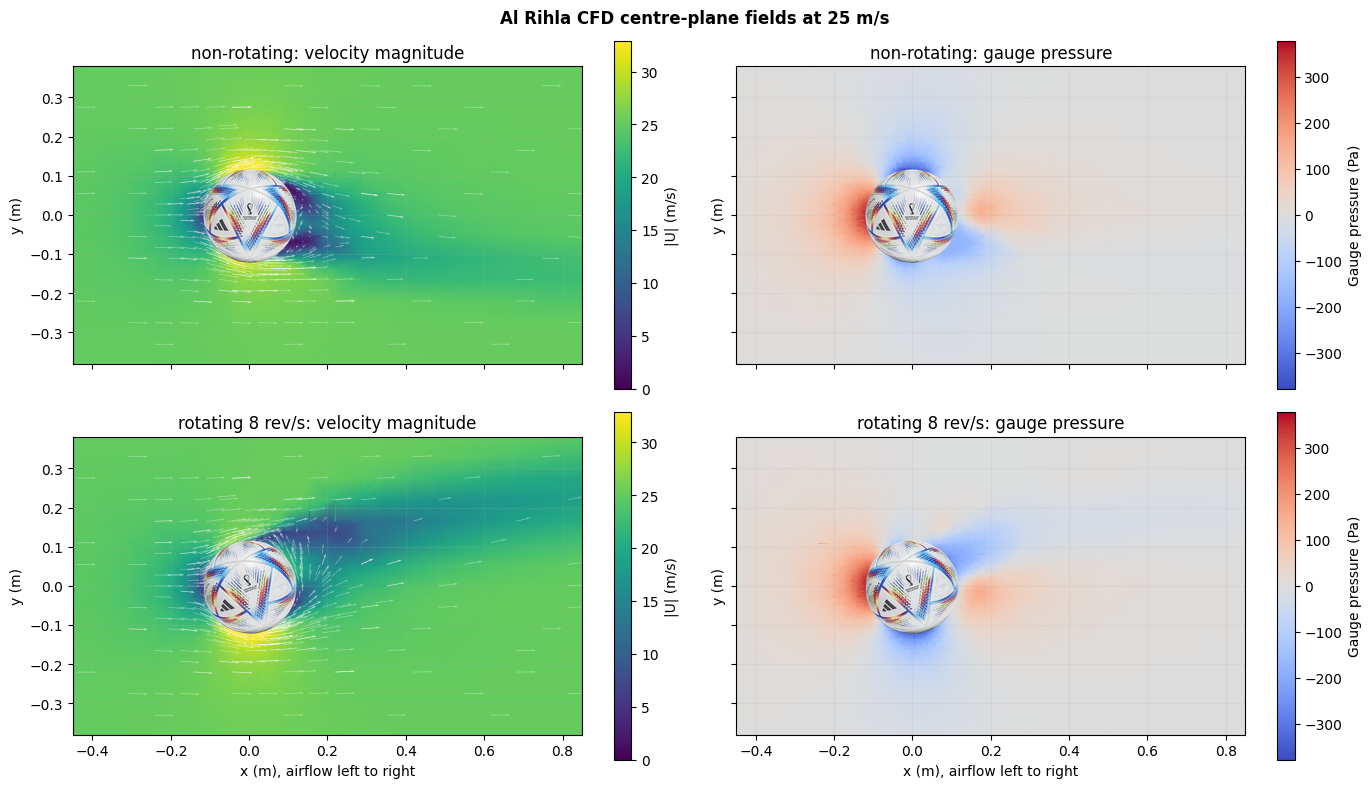
Flow
25 m/s
Rotation
0 and 8 rev/s
Method
OpenFOAM URANS
01
Geometry to CFD mesh
Audit, repair, scale, remesh, and validate STL or surface geometry before it reaches a solver.
02
Open-source solvers
Prepare reproducible OpenFOAM and SU2 cases with the solver settings and checks recorded.
03
Flow and force analysis
Extract pressure, velocity, drag, lift, moments, wake behavior, and uncertainty-aware comparisons.
04
Inspectable artifacts
Keep meshes, configurations, logs, result files, notebooks, and visual evidence connected to the study.
Example study · Al Rihla football
From a 3D-print file to a time-resolved aerodynamic study.
Vicena turns imperfect geometry into an inspectable scientific process: audit the input, repair the surface, reject weak meshes, run open-source solvers, and increase complexity only when the evidence supports it.
The public package includes the executed Jupyter notebook, attributed repaired STL, validation records, mesh-repair scripts, complete OpenFOAM cases, Vicena Compute submission templates, force histories, and compact pressure and velocity field data.
The source geometry is licensed under CC BY 4.0 and was modified for this exploratory study. Attribution, trademark notices, and scientific limitations are included in the archive.
This is the latest compact 263,891-cell, 0.05 s companion study. Some figures on this page intentionally document earlier workflow stages; the archive provenance and summary files identify the packaged reference results.
Independent exploratory study. Not official ball CAD or certified aerodynamic data.
SHA-256 checksumThe starting point
Science rarely starts with perfect geometry.
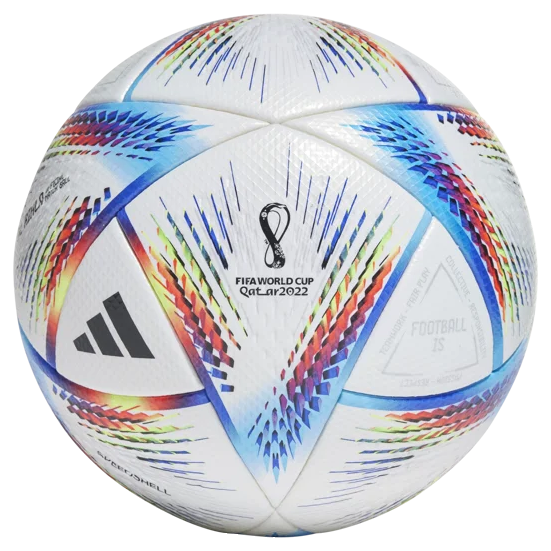
This case started with a downloadable 3D-printing model of the 2022 Al Rihla football. It looked detailed, but it was the wrong scale, formally non-watertight, and contained microscopic holes, a non-manifold edge, and triangles spanning an extreme size range.
The visible grooves could be useful for exploratory CFD, but the file contained no manufacturer metrology. Vicena preserved that uncertainty instead of presenting the model as certified ball geometry.
500,055
source triangles
91
boundary edges
29
microscopic holes
70.5
model-unit diameter
One continuous workflow
Every result earns the next level of complexity.
The value is not one dramatic flow image. It is a traceable chain of decisions in which inputs are questioned, failures are informative, and weak intermediate results do not quietly become scientific conclusions.
Start with the real input
Uploaded assetThe study began with a 3D-printable football model—not clean engineering CAD. Vicena treated it as an uncertain scientific input instead of assuming it was CFD-ready.
Audit before simulation
Geometry evidenceTopology, scale, orientation, triangle quality, holes, and non-manifold edges were measured. The first conclusion was revised when a better sphere fit changed the roughness estimate.
Repair and remesh
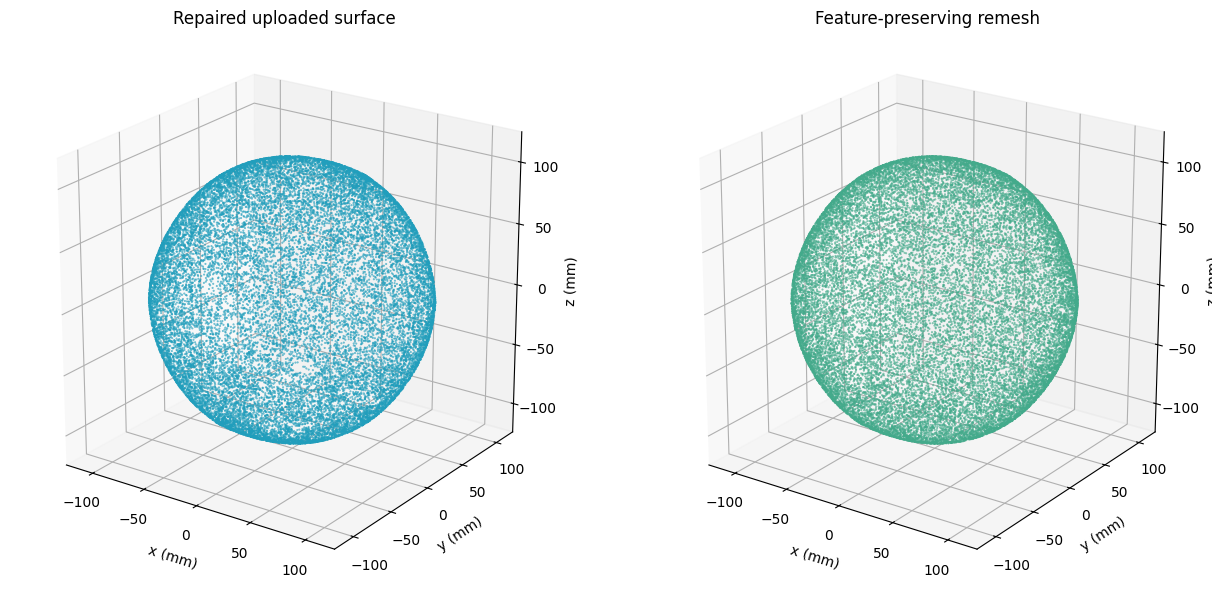
Validated surfaceThe surface was centered, scaled, repaired, and remeshed while preserving the supplied macroscopic features. OpenFOAM then independently checked the result.
Reject weak meshes
Quality gateSeveral volume meshes were deliberately not used for science. Skewed cells, concavity, missing prism layers, and an oversized refinement region were surfaced as evidence—not hidden.
Increase complexity carefully
Controlled progressionA smooth sphere established the solver and force-extraction baseline before transferring the workflow to the actual ball, rotation, and multiple fixed orientations.
Resolve the changing wake
Time-resolved CFDTransient URANS advanced the flow through physical time, producing force histories and wake snapshots rather than one frozen steady-state answer.
Geometry evidence
Repair the target before refining the air around it.
Refining the volume mesh could not fix collapsed and badly distributed triangles in the source surface. A feature-preserving remesh created a watertight, consistently oriented target with far more uniform triangles.
Scientific packages
The scientific packages behind geometry, meshing, and flow.
-

OpenFOAM
13
Primary CFD environment
Builds and checks volume meshes, solves steady and transient flow, and extracts pressure, velocity, and aerodynamic forces.
Official project -
snappyHexMesh
OpenFOAM 13
Body-fitted meshing
Turns validated surface geometry into a three-dimensional computational mesh with local surface and wake refinement.
Official project -

trimesh
4.12
Geometry audit and repair
Inspects connected bodies, boundaries, normals, scale, triangle quality, and surface deviations before CFD meshing.
Official project -

SU2
8.5
Aerodynamic verification
Provides an independent open-source route for airfoil, external-flow, multiphysics, and design-optimization studies.
Official project
From baseline to the real surface
Build confidence without skipping controls.
A smooth sphere first verified meshing, solver stability, and force extraction. The same workflow then moved to the repaired ball, comparing non-rotating and rotating cases at 25 m/s while retaining the actual field outputs.
The model challenged its own answer
A suspicious force became the next experiment.
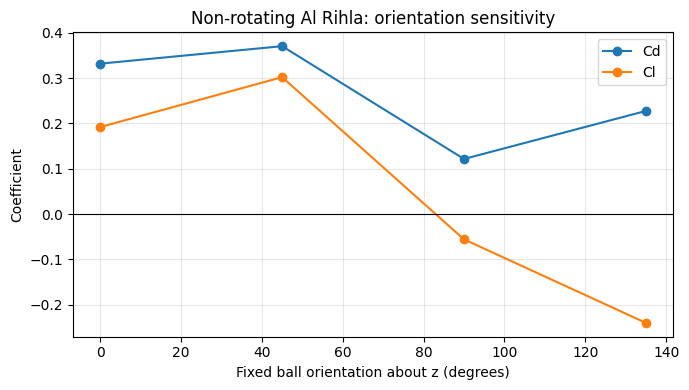
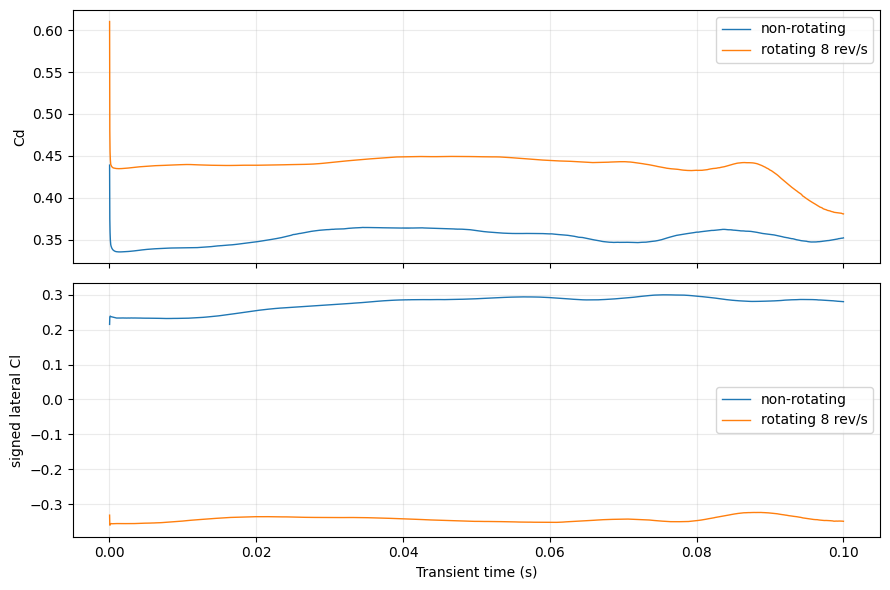
The non-rotating ball produced a surprisingly large lateral force. Instead of accepting it, Vicena rotated the same geometry through four fixed orientations. The predicted drag, wake, and lateral-force direction changed substantially—evidence that surface orientation and steady-state numerics needed deeper testing.
Scientific interpretation
The calculation confirmed orientation sensitivity in this numerical model. It did not prove that the predicted magnitude is physically correct.
0° → 135°
four controlled orientations
Sign change
lateral force reversed
Steady RANS
useful diagnostic, limited mean
Next gate
transient time averaging
Time-resolved airflow
From one frozen wake to a changing flow field.
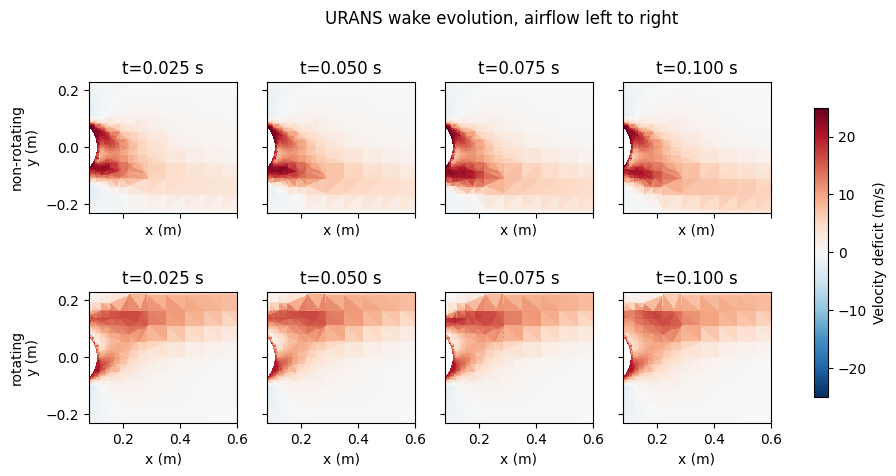
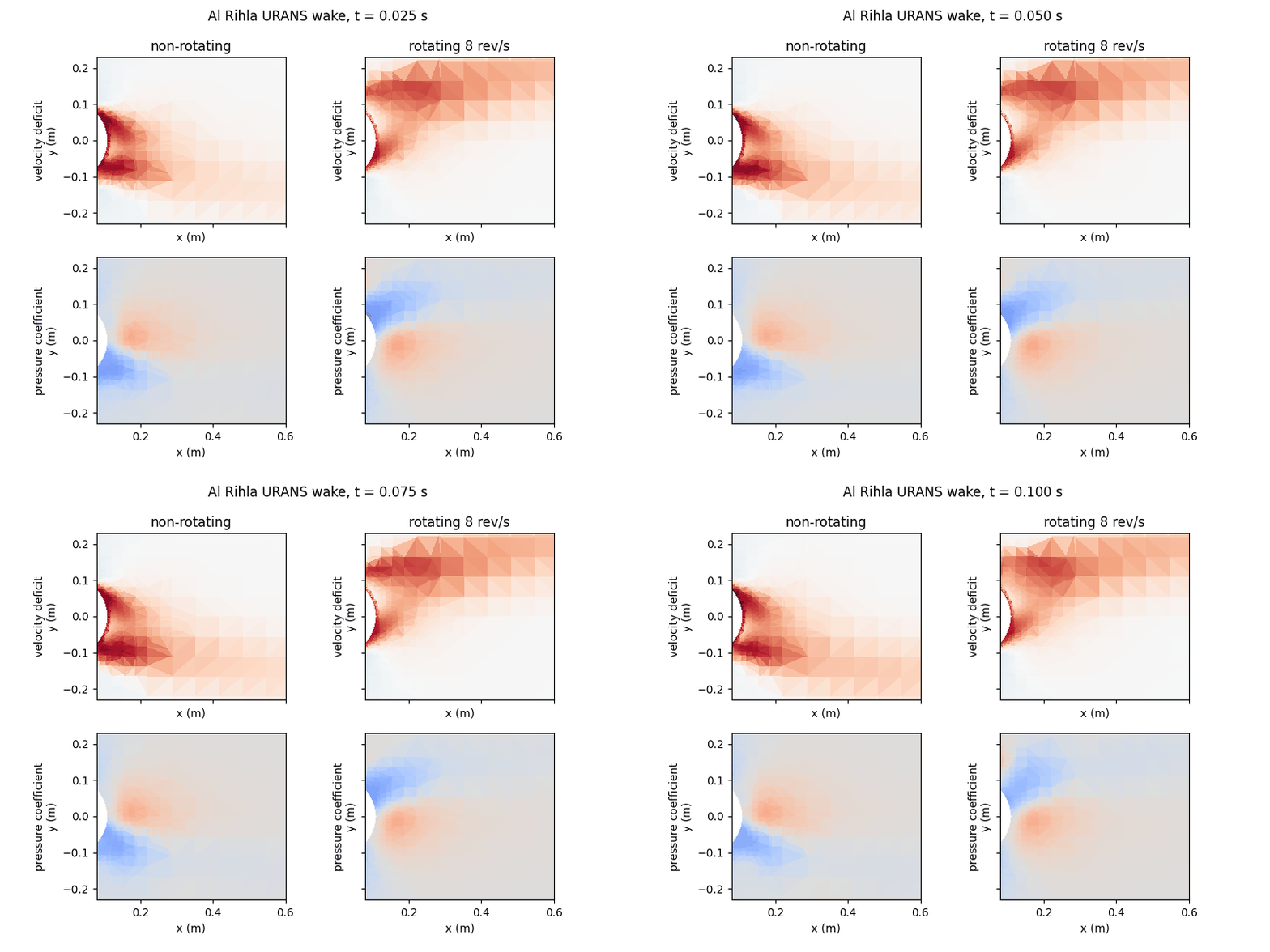
Transient URANS advanced pressure and velocity through physical time. Matching non-rotating and 8 rev/s pilots captured force histories and four actual wake states, revealing what a steady solution cannot.
A bounded pilot, not a final claim
The 0.10 s runs verified the workflow but were too short for statistically converged wake averages or a reliable shedding frequency.
Transient artifact
Wake comparison animation
Beyond this football
The workflow generalizes. The evidence stays case-specific.
Vicena reuses reliable workflow contracts for common CFD tasks while preserving room to build a new workflow when the geometry, physics, or solver requirements are different.
External aerodynamics
Airfoils, vehicles, drones, sports equipment, buildings, and bluff-body wakes.
Internal flows
Ducts, manifolds, valves, pressure losses, cooling channels, and flow distribution.
Rotating machinery
Fans, propellers, turbines, rotating bodies, moments, and spin-dependent forces.
Design exploration
Geometry comparisons, parameter sweeps, operating envelopes, and evidence-backed iteration.
Try a real engineering question
Start with the problem—not a solver command.
Bring the messy first file
Vicena can help turn it into a study you can inspect, challenge, and improve.
Beta workflows can still encounter solver, geometry, and resource limits. Vicena keeps those failures visible and returns the evidence needed to make the next attempt more informed.